

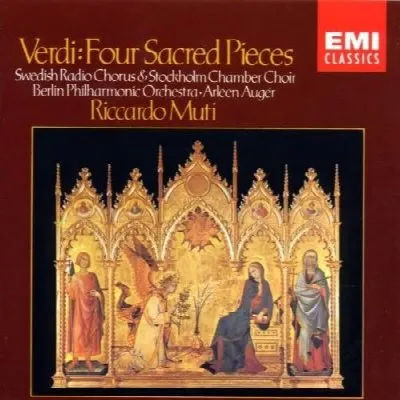
Elevation
Our rating, out of 100 — and why.
AI-generated from five scored dimensions. An opinion, not a measurement.
Verdi’s shifts between a cappella choral writing and orchestral climaxes give the four-piece sequence strong contrast and shape, with writing that rewards revisiting.
What we noticed
- The sequence alternates unaccompanied choral writing in “Ave Maria” and “Laudi alla Vergine” with the orchestral forces of “Stabat Mater” and “Te Deum.”
- “Stabat Mater” builds from restrained choral passages into forceful orchestral climaxes; the closing “Te Deum” adds a soprano solo and ends quietly.
- The four pieces move between intimate, exposed voices and full chorus with orchestra, giving the short sequence clear changes of scale.
- Composition 25% of the score
-
8/10
- Craft 20% of the score
-
8/10
- Durability 25% of the score
-
7/10
- Distinctiveness 18% of the score
-
7/10
- Sequencing 12% of the score
-
8/10
the writing — melody, harmony, structure, lyrics
production, performance, arrangement
whether it rewards returning to it
whether it sounds like itself
running order, pacing, length
Significant within its genre. Reported but not counted — how far a record travelled describes its reception rather than the record, and a newer release has had less time to travel than an older one.
Tracklist
Best experienced from track one — press play and let it unfold.
- 1 Ave Maria 5:57
- 2 Stabat Mater 12:47
- 3 Laudi alla Vergine 5:43
- 4 Te Deum (feat. soprano: Arleen Augér) 16:05
Reference: MusicBrainz
Sync your library
Everything you track here works immediately — no account needed. Create one when you want to sync across devices.