

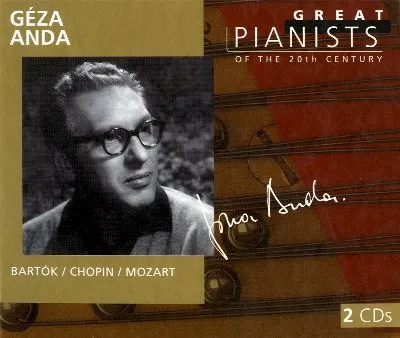
Great Pianists of the 20th Century: Géza Anda
Géza Anda · 1999
154 min · 25 tracks · classical music
Anda’s piano moves from Bartók’s percussive urgency to Mozart’s poised lyricism and the shifting dance rhythms of Chopin’s waltzes.
Top tracks — play these first
-
→
Piano Concerto no. 1: I. Allegro Moderato — Bartók’s opening movement sets the piano against a hard-edged orchestral sound, introducing the rhythmic precision central to Anda’s concerto playing.
-
→
Piano Concerto no. 2: II. Adagio - più adagio - presto — The movement’s slow outer sections surround a quick central episode, testing the contrast between hushed concentration and sudden rhythmic motion.
-
→
Piano Concerto no. 3: II. Adagio religioso — A spare, hymn-like opening gives way to nature-inspired sounds before returning to stillness, revealing a more contemplative side of Bartók’s concerto writing.
-
→
Piano Concerto no. 21 in C, KV. 467: II. Andante — Mozart’s gently flowing slow movement offers a striking change of scale after Bartók, with Anda’s melodic line suspended over a softly pulsing accompaniment.
-
→
Waltz in A minor, op. 34 no. 2 — This subdued Chopin waltz turns the dance into a melancholy solo scene, letting Anda shape its phrases without the support of an orchestra.
Elevation
Our rating, out of 100 — and why.
AI-generated from five scored dimensions. An opinion, not a measurement.
InstrumentalThe album showcases strong classical compositions with excellent performance, though it lacks broad cultural resonance.
What we noticed
- Each concerto is divided into three movements, maintaining a classical structure that emphasizes contrast between lyrical and energetic sections.
- Composition 25% of the score
-
8/10
- Craft 20% of the score
-
9/10
- Durability 25% of the score
-
7/10
- Distinctiveness 18% of the score
-
7/10
- Sequencing 12% of the score
-
6/10
the writing — melody, harmony, structure, lyrics
production, performance, arrangement
whether it rewards returning to it
whether it sounds like itself
running order, pacing, length
Little footprint beyond its audience. Reported but not counted — how far a record travelled describes its reception rather than the record, and a newer release has had less time to travel than an older one.
Tracklist
Best experienced from track one — press play and let it unfold.
Disc 1
- 1 Piano Concerto no. 1: I. Allegro Moderato 9:14
- 2 Piano Concerto no. 1: II. Andante 8:35
- 3 Piano Concerto no. 1: III. Allegro Molto 7:22
- 4 Piano Concerto no. 2: I. Allegro 9:50
- 5 Piano Concerto no. 2: II. Adagio - più adagio - presto 12:19
- 6 Piano Concerto no. 2: III. Allegro molto 6:22
- 7 Piano Concerto no. 3: I. Allegretto 7:13
- 8 Piano Concerto no. 3: II. Adagio religioso 10:16
- 9 Piano Concerto no. 3: III. Allegro vivace 6:46
Disc 2
- 1 Piano Concerto no. 21 in C, KV. 467: I. Allegro maestoso 13:53
- 2 Piano Concerto no. 21 in C, KV. 467: II. Andante 7:12
- 3 Piano Concerto no. 21 in C, KV. 467: III. Allegro vivace assai 6:31
- 4 Waltz in E-flat major, op. 18 "Grande Valse Brillante" 6:02
- 5 Waltz in A-flat major, op. 34 no. 1 "Valse Brillante" 6:15
- 6 Waltz in A minor, op. 34 no. 2 5:49
- 7 Waltz in F major, op. 34 no. 3 ''Valse Brillante'' 2:47
- 8 Waltz in A-flat major, op. 42 ''Grande Valse'' 4:29
- 9 Waltz in D-flat major, op. 64 no. 1 "Minute" 2:09
- 10 Waltz in C-sharp minor, op. 64 no. 2 3:47
- 11 Waltz in A-flat major, op. 64 no. 3 3:35
- 12 Waltz in A-flat major, op. 69 no. 1 "Farewell" 3:44
- 13 Waltz in B minor, op. 69 no. 2 3:49
- 14 Waltz in G-flat major, op. 70 no. 1 2:24
- 15 Waltz in F minor, op. 70 no. 2 1:48
- 16 Waltz in D-flat major, op. 70 no. 3 2:39
What to play next
Reference: Wikipedia · MusicBrainz · Wikidata
Sync your library
Everything you track here works immediately — no account needed. Create one when you want to sync across devices.