

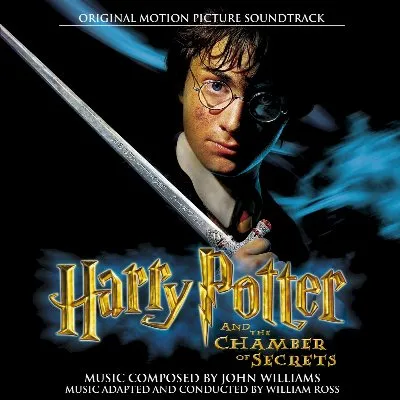
Released 24 years ago this November
Harry Potter and the Chamber of Secrets
John Williams · 2002
70 min · 20 tracks · contemporary classical music
John Williams’s orchestra moves from buoyant wizarding adventure into shadowy chambers where danger gathers beneath familiar magic.
Top tracks — play these first
-
→
Prologue: Book II / The Escape From the Dursleys Start here — establishes the sonic palette early
-
→
Fawkes the Phoenix — A broad, lyrical theme gives Dumbledore’s phoenix a sense of grace distinct from the score’s more mischievous character music.
-
→
Gilderoy Lockhart — A jaunty march suits the professor’s polished public persona, letting the orchestra participate in the character’s comedy.
-
→
The Spiders — Agitated orchestral writing turns the Forbidden Forest encounter into a sustained burst of pursuit and threat.
-
→
Harry's Wondrous World — The returning theme from the first film closes the album by reconnecting the darker adventure with the series’ original sense of discovery.
Elevation
Our rating, out of 100 — and why.
AI-generated from five scored dimensions. An opinion, not a measurement.
InstrumentalThe album showcases rich orchestration and thematic development, characteristic of Williams' film scoring style.
What we noticed
- The album includes both whimsical and suspenseful pieces, with tempo changes that reflect the narrative's emotional shifts, particularly in tracks like 'The Chamber of Secrets' and 'Moaning Myrtle'.
- The final track, 'Harry's Wondrous World', serves as a thematic culmination, revisiting earlier motifs and providing a sense of closure to the score.
- Composition 25% of the score
-
8/10
- Craft 20% of the score
-
9/10
- Durability 25% of the score
-
7/10
- Distinctiveness 18% of the score
-
7/10
- Sequencing 12% of the score
-
8/10
the writing — melody, harmony, structure, lyrics
production, performance, arrangement
whether it rewards returning to it
whether it sounds like itself
running order, pacing, length
Significant within its genre. Reported but not counted — how far a record travelled describes its reception rather than the record, and a newer release has had less time to travel than an older one.
Is this for you?
Good fit if you like
- whimsical melodies for imagination
- dynamic narrative journey unfolds
- wave-like pacing with surprises
- transportive themes of enchantment
- evocative orchestral storytelling
Maybe skip if you
- prefer straightforward, fast-paced music
- avoid long, cohesive listening experiences
Where this album fits
- In the catalog
- Breakthrough — This score followed a successful first installment, solidifying Williams' reputation in film scoring.
- Themes
- Hogwarts mysteries· Chamber of Secrets· Fawkes's rebirth· Basilisk combat
- Career context
- Released in 2002, this was Williams’s second Harry Potter score, following Harry Potter and the Sorcerer’s Stone in 2001. Williams introduced new themes alongside returning material, while William Ross adapted and conducted portions of the score.
- Stylistic neighbors
- Ennio Morricone· Howard Shore· James Horner
Moments worth listening for
Where the writing does something specific.
-
Harry's Wondrous World
The closing track returns to a theme introduced in the first film; it is an instrumental passage rather than a lyric.
Reusing the melody at the album’s close gives the sequel a musical link to Harry’s earlier arrival in the wizarding world.
Tracklist
- 1 Prologue: Book II / The Escape From the Dursleys Start here 3:31
- 2 Fawkes the Phoenix 3:45
- 3 The Chamber of Secrets 3:49
- 4 Gilderoy Lockhart 2:05
- 5 The Flying Car 4:08
- 6 Knockturn Alley 1:47
- 7 Introducing Colin 1:49
- 8 The Dueling Club 4:08
- 9 Dobby the House Elf 3:27
- 10 The Spiders 4:32
- 11 Moaning Myrtle 2:05
- 12 Meeting Aragog 3:18
- 13 Fawkes Is Reborn 3:19
- 14 Meeting Tom Riddle 3:38
- 15 Cornish Pixies 2:13
- 16 Polyjuice Potion 3:52
- 17 Cakes for Crabbe and Goyle 3:30
- 18 Dueling the Basilisk 5:02
- 19 Reunion of Friends 5:08
- 20 Harry's Wondrous World 5:02
Reference: Wikipedia · MusicBrainz · Wikidata
Sync your library
Everything you track here works immediately — no account needed. Create one when you want to sync across devices.