

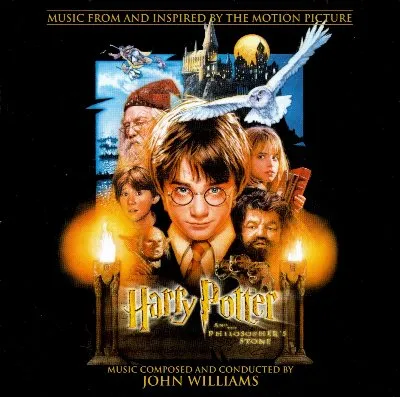
Harry Potter and the Philosopher's Stone (Original Motion Picture Soundtrack)
John Williams · 2001
73 min · 19 tracks · contemporary classical music
Celesta-lit wonder opens into an orchestral world where playful discovery gives way to shadows and danger.
Top tracks — play these first
-
→
Prologue — The opening introduces the delicate celesta sound that makes the magical world feel mysterious before the orchestra expands around it.
-
→
Harry's Wondrous World Start here — A sweeping concert-style presentation turns Harry’s discovery of Hogwarts into an expansive orchestral adventure.
-
→
The Chess Game — Driving orchestral writing gives the life-size chess sequence its mounting urgency, revealing the score’s capacity for danger as well as enchantment.
-
→
Hedwig's Theme — The closing concert arrangement develops the film’s central musical signature beyond its opening celesta statement.
Elevation
Our rating, out of 100 — and why.
AI-generated from five scored dimensions. An opinion, not a measurement.
InstrumentalThe score effectively captures the film's magic through strong motifs and orchestral variety.
What we noticed
- The album features a recurring motif in 'Hedwig's Theme', which appears in various forms throughout the score, creating thematic cohesion.
- Tracks are structured around key scenes from the film, with orchestration that shifts dramatically to match the emotional tone of each moment.
- The use of different instrument families, such as strings for warmth and brass for grandeur, highlights the contrasting moods within the narrative.
- Composition 25% of the score
-
8/10
- Craft 20% of the score
-
9/10
- Durability 25% of the score
-
7/10
- Distinctiveness 18% of the score
-
8/10
- Sequencing 12% of the score
-
8/10
the writing — melody, harmony, structure, lyrics
production, performance, arrangement
whether it rewards returning to it
whether it sounds like itself
running order, pacing, length
Significant within its genre. Reported but not counted — how far a record travelled describes its reception rather than the record, and a newer release has had less time to travel than an older one.
Is this for you?
Good fit if you like
- whimsical adventure soundscapes
- dynamic orchestral storytelling
- immersive cinematic moments
- magical nostalgia for childhood
- wave-like emotional crescendos
Maybe skip if you
- instant gratification seekers
- minimalist soundscape enthusiasts
Where this album fits
- In the catalog
- Breakthrough — Established Williams' reputation with a major franchise, gaining wider recognition.
- Themes
- Hogwarts discovery· Quidditch flight· Harry's first-year adventure
- Career context
- Released in 2001, this was John Williams’s first score for the Harry Potter films, arriving decades after his career-defining work on Star Wars and E.T. the Extra-Terrestrial. He went on to score the next two Potter films, establishing themes that would remain associated with the series.
- Stylistic neighbors
- Jerry Goldsmith· James Horner· Alan Silvestri
Tracklist
- 1 Prologue 2:12
- 2 Harry's Wondrous World Start here 5:20
- 3 The Arrival of Baby Harry 4:25
- 4 Visit to the Zoo / Letters from Hogwarts 3:23
- 5 Diagon Alley / The Gringotts Vault 4:06
- 6 Platform Nine-and-Three-Quarters / The Journey to Hogwarts 3:13
- 7 Entry into the Great Hall / The Banquet 3:42
- 8 Mr. Longbottom Flies 3:34
- 9 Hogwarts Forever! / The Moving Stairs 3:46
- 10 The Norwegian Ridgeback / A Change of Season 2:47
- 11 The Quidditch Match 8:28
- 12 Christmas at Hogwarts 2:55
- 13 The Invisibility Cloak / The Library Scene 3:16
- 14 Fluffy's Harp 2:38
- 15 In the Devil's Snare / The Flying Keys 2:20
- 16 The Chess Game 3:48
- 17 The Face of Voldemort 6:10
- 18 Leaving Hogwarts 2:13
- 19 Hedwig's Theme 5:11
Reference: Wikipedia · MusicBrainz · Wikidata
Sync your library
Everything you track here works immediately — no account needed. Create one when you want to sync across devices.