

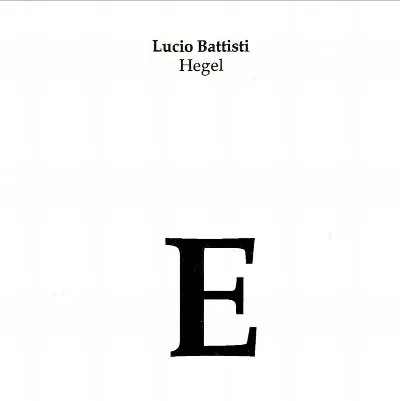
Released 32 years ago this November
Hegel
Lucio Battisti · 1994
38 min · 8 tracks · pop music
A contemplative blend of pop and progressive rock, merging introspective lyrics with lush melodic arrangements.
Top tracks — play these first
-
→
Hegel — The title track serves as a philosophical exploration of existence, intertwining Battisti's reflective songwriting with intricate musical arrangements that exemplify his evolution as an artist.
-
→
La bellezza riunita — This track stands out for its rich instrumentation and poignant lyrics, encapsulating the album's overarching themes of beauty and unity within a modern context.
-
→
Almeno l’inizio — Opening with striking melodies, this song captures the essence of Battisti’s lyrical introspection and sets a contemplative tone for the entire album.
Elevation
Our rating, out of 100 — and why.
AI-generated from five scored dimensions. An opinion, not a measurement.
The album blends introspective lyrics with complex arrangements, rewarding careful listening while maintaining a cohesive flow.
What we noticed
- The album opens with a slow tempo track that gradually builds in complexity, introducing layered instrumentation and harmonies.
- Several tracks feature extended instrumental sections that allow for atmospheric exploration, particularly in 'La bellezza riunita' and 'Estetica'.
- Lyrically, the songs delve into philosophical themes, often using metaphorical language that requires attentive listening to unpack.
- The final track concludes with a gradual fade-out, leaving an unresolved feeling that echoes the album's introspective nature.
- Composition 25% of the score
-
7/10
- Craft 20% of the score
-
6/10
- Durability 25% of the score
-
6/10
- Distinctiveness 18% of the score
-
6/10
- Sequencing 12% of the score
-
7/10
the writing — melody, harmony, structure, lyrics
production, performance, arrangement
whether it rewards returning to it
whether it sounds like itself
running order, pacing, length
Known within its scene. Reported but not counted — how far a record travelled describes its reception rather than the record, and a newer release has had less time to travel than an older one.
Is this for you?
Good fit if you like
- steady mid-tempo introspection
- philosophical themes to ponder
- consistent flow for deep listening
- melodic reflections on beauty
Maybe skip if you
- seeking instant gratification
- prefer upbeat party tracks
Where this album fits
- In the catalog
- Experimental — Its abstract, philosophical lyrics and unconventional pop arrangements extend Battisti's late-career break from his e...
- Career context
- By the release of Hegel in November 1994, Lucio Battisti was navigating a complex phase in his career, marked by a hiatus from public life after his previous album, La sposa occidentale, in 1986. This record represented a significant return, showcasing his ability to evolve artistically while maintaining his signature sound amidst changing musical landscapes.
- Stylistic neighbors
- Alan Sorrenti· Matia Bazar· Franco Battiato
Tracklist
Best experienced from track one — press play and let it unfold.
- 1 Almeno l’inizio 4:57
- 2 Hegel 5:15
- 3 Tubinga 4:54
- 4 La bellezza riunita 5:07
- 5 La moda nel respiro 4:22
- 6 Stanze come questa 4:38
- 7 Estetica 5:11
- 8 La voce del viso 4:13
What to play next
Cosa succederà alla ragazza
1992
Its adventurous late-period pop and shared lyricist make it a natural step back from Hegel’s reflective sound.
La sposa occidentale
1990
Its late-period textures and collaboration with Pasquale Panella lead toward Hegel’s more contemplative experiments.
Reference: Wikipedia · MusicBrainz · Wikidata
Sync your library
Everything you track here works immediately — no account needed. Create one when you want to sync across devices.