

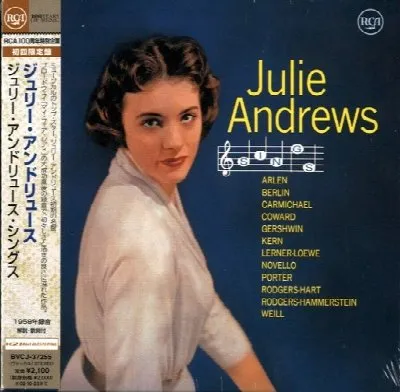
Julie Andrews Sings
Julie Andrews · 1958
30 min · 12 tracks
A clear theatrical soprano brings an intimate touch to a songbook that moves from springtime longing to maritime melancholy.
Top tracks — play these first
-
→
It Might as Well Be Spring Start here — The Rodgers and Hammerstein song gives Andrews room to turn seasonal imagery into restless anticipation, setting a wistful tone for the collection.
-
→
We’ll Gather Lilacs in the Spring — Ivor Novello’s wartime song brings a distinctly British theatrical tradition to the album, with its promise of reunion suspended between hope and absence.
-
→
My Ship — Kurt Weill and Ira Gershwin’s fantasy of riches becomes a compact dramatic scene, ending with a condition that changes the meaning of its imagined treasure.
-
→
Matelot — Noël Coward’s sailor song closes the record on a more somber note, its story of devotion and loss giving Andrews a miniature drama to inhabit.
Elevation
Our rating, out of 100 — and why.
AI-generated from five scored dimensions. An opinion, not a measurement.
Andrews' vocal delivery and orchestration create a charming experience, though it follows established show tune conventions.
What we noticed
- The album features a consistent orchestral arrangement throughout, with lush strings and woodwinds accompanying Andrews' vocals.
- Each track showcases a different emotional tone, ranging from playful to deeply romantic, allowing for varied interpretations of the material.
- The first half of the album maintains a moderate tempo, while the latter half introduces slower ballads that emphasize vocal expression.
- Composition 25% of the score
-
7/10
- Craft 20% of the score
-
8/10
- Durability 25% of the score
-
6/10
- Distinctiveness 18% of the score
-
6/10
- Sequencing 12% of the score
-
7/10
the writing — melody, harmony, structure, lyrics
production, performance, arrangement
whether it rewards returning to it
whether it sounds like itself
running order, pacing, length
Known within its scene. Reported but not counted — how far a record travelled describes its reception rather than the record, and a newer release has had less time to travel than an older one.
Is this for you?
Good fit if you like
- steady melodic flow throughout
- warm nostalgia for classic tunes
- short, delightful sing-along moments
- for afternoon relaxation
Maybe skip if you
- prefer longer, complex arrangements
- seek high-energy dance tracks
Where this album fits
- In the catalog
- Breakthrough — Established her reputation post-My Fair Lady, enhancing her prominence in music.
- Themes
- Broadway standards· springtime restlessness· ballroom courtship· shipboard daydreams
- Career context
- Julie Andrews released this album in 1958, while her Broadway success as Eliza Doolittle in My Fair Lady was establishing her as a major stage star. The collection draws on songs by writers including Rodgers and Hammerstein, Cole Porter and Noël Coward, extending her recorded repertoire beyond the role that made her famous.
- Stylistic neighbors
- Ella Fitzgerald· Barbra Streisand· Bette Midler
Tracklist
- 1 It Might as Well Be Spring Start here 2:31
- 2 Falling in Love With Love 2:22
- 3 We’ll Gather Lilacs in the Spring 2:53
- 4 He Loves and She Loves 2:45
- 5 I’m Old-Fashioned 2:34
- 6 You’re a Builder-Upper 2:26
- 7 Little Old Lady 2:24
- 8 My Ship 2:09
- 9 Cheek to Cheek 2:01
- 10 Come to Me, Bend to Me 2:05
- 11 So in Love 2:37
- 12 Matelot 3:45
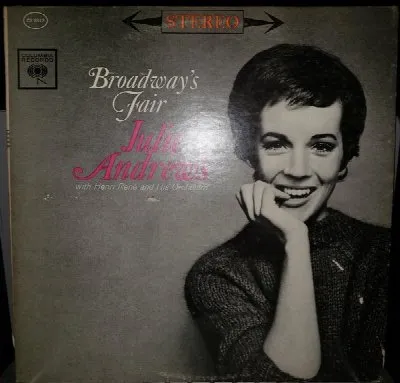

If this landed
Records by other artists that run on the same instinct.
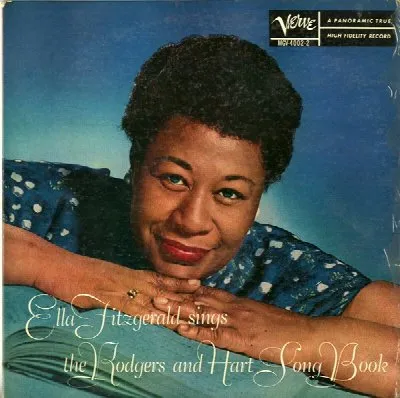
Ella Fitzgerald Sings the Rodgers and Hart Songbook
Ella Fitzgerald
A poised voice brings Broadway standards into an intimate setting, with the same focus on lyrical longing.
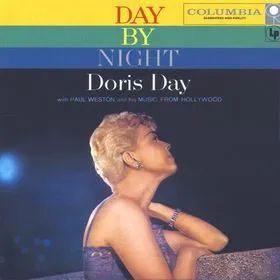
Day by Night
Doris Day
Moves through standards of courtship and longing with a clear vocal and restrained, late-night orchestral backing.
Reference: Wikipedia · MusicBrainz · Wikidata
Sync your library
Everything you track here works immediately — no account needed. Create one when you want to sync across devices.