

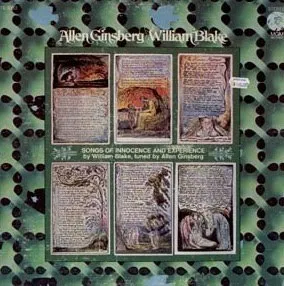
Songs of Innocence and Experience
Allen Ginsberg · 1970
37 min · 19 tracks
Ginsberg’s incantatory voice carries Blake’s poems through spare folk melodies with an improviser’s freedom and a devotional intensity.
Top tracks — play these first
-
→
(a) Introduction / (b) The Shepherd Start here — narrative starting point that establishes the album's frame
-
→
The Lamb — Its direct address and gently questioning form suit Ginsberg’s unadorned delivery, establishing the devotional character of Blake’s innocence poems.
-
→
The Chimney Sweeper — A child’s account of labor and consolation brings social cruelty into the album’s early sequence, complicating its apparently innocent perspective.
-
→
The Garden of Love — The poem’s movement from a remembered open space to a place governed by prohibition makes the darker outlook of the experience sequence sharply audible.
-
→
London — Ginsberg delivers Blake’s street-level vision of confinement and suffering as a concentrated social indictment, extending the album’s religious concerns into public life.
Elevation
Our rating, out of 100 — and why.
AI-generated from five scored dimensions. An opinion, not a measurement.
The album showcases Ginsberg's poetic style through varied delivery and concise tracks, though it lacks strong thematic cohesion.
What we noticed
- The album features a spoken word format where Ginsberg recites poems with minimal instrumental backing, emphasizing the lyrical content.
- Each track is relatively short, often under three minutes, creating a quick succession of ideas and themes.
- Ginsberg's delivery varies from contemplative to urgent, reflecting the emotional weight of the texts he presents.
- Composition 25% of the score
-
6/10
- Craft 20% of the score
-
7/10
- Durability 25% of the score
-
5/10
- Distinctiveness 18% of the score
-
8/10
- Sequencing 12% of the score
-
4/10
the writing — melody, harmony, structure, lyrics
production, performance, arrangement
whether it rewards returning to it
whether it sounds like itself
running order, pacing, length
Known within its scene. Reported but not counted — how far a record travelled describes its reception rather than the record, and a newer release has had less time to travel than an older one.
Is this for you?
Good fit if you like
- brief poem-by-poem meditations
- incantatory readings over spare melodies
- devotional moods with shadowed turns
- a compact cycle of contrasting
Maybe skip if you
- want polished, tightly arranged songs
- prefer long instrumental passages
Where this album fits
- In the catalog
- Experimental — Sets Blake’s poetry to spare folk melodies, extending Ginsberg’s spoken-word work into a distinctive musical format.
- Career context
- Released in 1970, Songs of Innocence and Experience followed Ginsberg’s emergence as a central Beat poet with Howl and Other Poems in 1956. The album brought a long-standing engagement with William Blake into a musical setting, with Ginsberg singing poems from Blake’s paired collections.
- Stylistic neighbors
- William S. Burroughs· Patti Smith· The Last Poets
Tracklist
- 1 (a) Introduction / (b) The Shepherd Start here 2:10
- 2 The Echoing Green 1:22
- 3 The Lamb 1:10
- 4 The Little Black Boy 3:00
- 5 The Blossom 1:22
- 6 The Chimney Sweeper 2:20
- 7 The Little Boy Lost 1:06
- 8 (a) The Little Boy Found / (b) Laughing Song 1:24
- 9 Holy Thursday 1:15
- 10 Night 3:57
- 11 Introduction 2:06
- 12 Nurses Song 2:07
- 13 The Sick Rose 1:35
- 14 Ah! Sun-Flower 1:12
- 15 The Garden of Love 1:02
- 16 London 1:55
- 17 The Human Abstract 2:30
- 18 To Tirzah 1:42
- 19 The Grey Monk 4:06
Reference: Wikipedia · MusicBrainz · Wikidata
Sync your library
Everything you track here works immediately — no account needed. Create one when you want to sync across devices.