

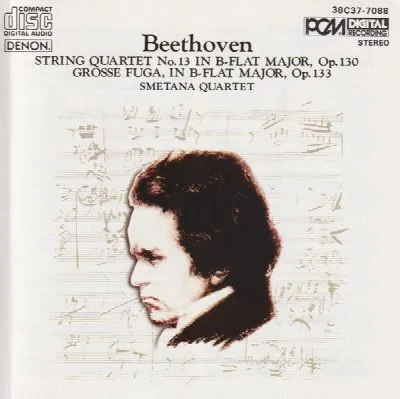
Elevation
Our rating, out of 100 — and why.
AI-generated from five scored dimensions. An opinion, not a measurement.
InstrumentalThe late quartet’s abrupt changes of scale and the fugue’s architectural density sustain repeated listening; the unidentified performance prevents a stronger craft judgment.
What we noticed
- The first four movements alternate a sonata-form opening with short, sharply contrasting dances; the fifth slows to the Cavatina before the large fugue.
- The catalogued sequence places the Grosse Fuge immediately before a separate Allegro finale, giving the closing stretch two distinct endings.
- Composition 25% of the score
-
10/10
- Craft 20% of the score
-
6/10
- Durability 25% of the score
-
9/10
- Distinctiveness 18% of the score
-
10/10
- Sequencing 12% of the score
-
7/10
the writing — melody, harmony, structure, lyrics
production, performance, arrangement
whether it rewards returning to it
whether it sounds like itself
running order, pacing, length
Defined its genre or moment. Reported but not counted — how far a record travelled describes its reception rather than the record, and a newer release has had less time to travel than an older one.
Tracklist
Best experienced from track one — press play and let it unfold.
- 1 String Quartet in B-flat major, op. 130 (133): Adagio ma non troppo. Allegro 13:21
- 2 String Quartet in B-flat major, op. 130 (133): Presto 1:58
- 3 String Quartet in B-flat major, op. 130 (133): Andante con moto ma non troppo 6:45
- 4 String Quartet in B-flat major, op. 130 (133): Alla danza tedesca. Allegro assai 3:15
- 5 String Quartet in B-flat major, op. 130 (133): Cavatina. Adagio molto espressivo 7:00
- 6 String Quartet in B-flat major, op. 130 (133): Grosse Fuge in B-flat major (op. 133) 14:36
- 7 String Quartet in B-flat major, op. 130 (133): Finale. Allegro 9:28

Reference: MusicBrainz
Sync your library
Everything you track here works immediately — no account needed. Create one when you want to sync across devices.