

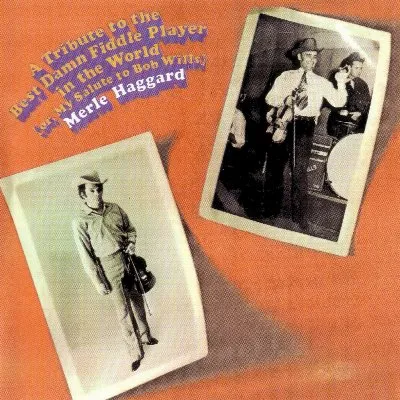
Released 56 years ago this November
A Tribute to the Best Damn Fiddle Player in the World
Merle Haggard · 1970
31 min · 12 tracks · country music
Fiddles dart through buoyant Western swing as a country voice joins the dance with easy affection.
Top tracks — play these first
-
→
Right or Wrong Start here — accessible entry with immediate hook
-
→
Brown Skinned Gal (with Narration) — The brief narrated opener frames the record as a personal salute before the band takes up Wills’s swinging language.
-
→
Brain Cloudy Blues — Blues phrasing and a loose swing pulse give the players room to stretch, revealing how readily the tribute moves beyond straight country.
-
→
Time Changes Everything — Haggard’s measured delivery gives this Wills-associated ballad an air of hard-earned acceptance amid the album’s livelier dance tunes.
-
→
San Antonio Rose — The familiar melody puts the fiddle-led ensemble at the center, connecting Haggard’s tribute directly to one of Wills’s signature compositions.
-
→
Take Me Back to Tulsa — Its brisk dance rhythm closes the album on a communal note, emphasizing the Texas Playboys’ repertoire as music made to be played and enjoyed.
Elevation
Our rating, out of 100 — and why.
AI-generated from five scored dimensions. An opinion, not a measurement.
The album blends traditional country with western swing elements, showcasing Haggard's storytelling and musical craftsmanship.
What we noticed
- Several tracks include spoken narration that introduces the songs, creating a storytelling atmosphere.
- The tempo varies significantly across the tracklist, with some songs maintaining a lively pace while others slow down for emotional impact.
- Composition 25% of the score
-
6/10
- Craft 20% of the score
-
7/10
- Durability 25% of the score
-
6/10
- Distinctiveness 18% of the score
-
6/10
- Sequencing 12% of the score
-
5/10
the writing — melody, harmony, structure, lyrics
production, performance, arrangement
whether it rewards returning to it
whether it sounds like itself
running order, pacing, length
Known within its scene. Reported but not counted — how far a record travelled describes its reception rather than the record, and a newer release has had less time to travel than an older one.
Is this for you?
Good fit if you like
- heartfelt storytelling through melodies
- steady mid-tempo flow throughout
- nostalgic vibes with lively fiddles
- for casual gatherings
Maybe skip if you
- prefer fast-paced listening experiences
- seek experimental or avant-garde sounds
Where this album fits
- In the catalog
- Breakthrough — This album helped solidify Haggard's reputation in country music after his initial success.
- Themes
- Bob Wills tribute· Texas western swing· fiddle-led dance halls· Tulsa dance halls
- Career context
- Released in 1970, the album followed Merle Haggard’s breakthrough with “Okie from Muskogee” and his earlier tribute to Jimmie Rodgers, Same Train, a Different Time. Here he turned to Bob Wills and Western swing, recording with members of Wills’s Texas Playboys alongside his own band.
- Stylistic neighbors
- Buck Owens· Wynn Stewart· Waylon Jennings
Moments worth listening for
Where the writing does something specific.
-
Time Changes Everything
The opening recalls a couple whose hearts once beat together, then turns to a refrain accepting that even love can change.
The move from a specific shared past to a broad conclusion gives the refrain the weight of a lesson learned rather than a prediction.
Tracklist
- 1 Brown Skinned Gal (with Narration) 0:50
- 2 Right or Wrong Start here 2:36
- 3 Brain Cloudy Blues 3:38
- 4 Stay a Little Longer 2:48
- 5 Misery 3:19
- 6 Time Changes Everything 2:37
- 7 San Antonio Rose 2:39
- 8 I Knew the Moment I Lost You 3:00
- 9 Roly Poly 2:39
- 10 Old Fashioned Love 2:32
- 11 Corrine Corrina 2:16
- 12 Take Me Back to Tulsa 2:38
If this landed
Records by other artists that run on the same instinct.
Reference: Wikipedia · MusicBrainz · Wikidata
Sync your library
Everything you track here works immediately — no account needed. Create one when you want to sync across devices.