

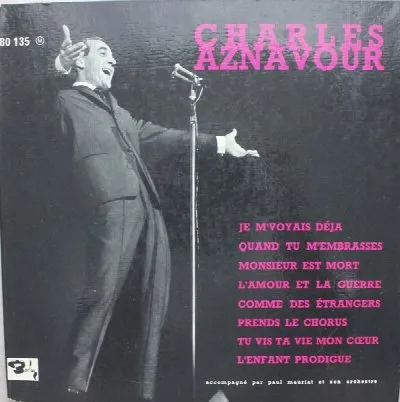
Charles Aznavour
Charles Aznavour · 1961
52 min · 19 tracks · jazz
Melodic storytelling intertwines with rich orchestration, creating an intimate atmosphere that captures the essence of French chanson.
Top tracks — play these first
-
→
Les Deux Guitares Start here — establishes the sonic palette early
-
→
Je m’voyais déjà — This track encapsulates Aznavour's poignant lyricism and self-reflective narrative style, illustrating dreams of success tinged with nostalgia. Its memorable melody and heartfelt delivery captured the imaginations of listeners across generations.
-
→
Tu t’laisses aller — With its playful tone, this song highlights Aznavour's versatility and charm, showcasing his knack for balancing humor with deeper emotional undertones. It's a perfect example of how he could blend lightheartedness with significant themes.
-
→
Quand tu m’embrasses — This romantic ballad stands out for its lush arrangement and tender lyrics, revealing Aznavour's deep connection to themes of love and longing. The arrangement complements his vocal delivery, enhancing the emotional weight of the song.
Elevation
Our rating, out of 100 — and why.
AI-generated from five scored dimensions. An opinion, not a measurement.
Aznavour's emotive melodies and lyrical depth create a strong listening experience, though the cohesion is affected by its length.
What we noticed
- Several tracks employ a call-and-response structure between Aznavour's vocals and instrumental sections, enhancing the storytelling aspect.
- The tempo varies significantly across the album, with some tracks maintaining a slow ballad feel while others introduce more upbeat rhythms.
- Composition 25% of the score
-
8/10
- Craft 20% of the score
-
7/10
- Durability 25% of the score
-
6/10
- Distinctiveness 18% of the score
-
7/10
- Sequencing 12% of the score
-
5/10
the writing — melody, harmony, structure, lyrics
production, performance, arrangement
whether it rewards returning to it
whether it sounds like itself
running order, pacing, length
Known within its scene. Reported but not counted — how far a record travelled describes its reception rather than the record, and a newer release has had less time to travel than an older one.
Is this for you?
Good fit if you like
- steady melodic journey throughout
- poignant reflections on love
- evocative storytelling with warmth
- intimate moments for quiet evenings
Maybe skip if you
- prefer upbeat, fast-paced music
- seek standalone hit singles
Where this album fits
- In the catalog
- Breakthrough — This album solidified Aznavour's reputation in French chanson, following earlier successes.
- Themes
- artist's disillusionment· Parisian night longing· romantic balladry
- Career context
- Released in 1961, this self-titled album marked Charles Aznavour's emergence as a significant figure in the French music scene following his earlier successes. By this time, he had already begun to establish his reputation, but this album solidified his status as an influential artist capable of blending personal narrative with broader themes of love and loss.
- Stylistic neighbors
- Édith Piaf· Jacques Brel· Françoise Hardy
Tracklist
- 1 Les Deux Guitares Start here 3:53
- 2 Ce jour tant attendu 2:11
- 3 Fraternité 2:14
- 4 J’ai des millions de rien du tout 2:40
- 5 J’ai perdu la tête 2:50
- 6 Tu t’laisses aller 3:43
- 7 Rendez-vous à Brasilia 2:05
- 8 La Nuit 3:03
- 9 C’n’est pas nécessairement ça 2:27
- 10 Plus heureux que moi 2:23
- 11 Je m’voyais déjà 3:26
- 12 Quand tu m’embrasses 2:12
- 13 Noël des mages 4:31
- 14 L’Amour et la Guerre 2:38
- 15 Comme des étrangers 2:27
- 16 Prends le chorus 2:36
- 17 Tu vis ta vie, mon cœur 2:10
- 18 L’Enfant prodigue 2:31
- 19 Monsieur est mort 2:41
What to play next

The Time is Now
1962
Continues the emotive themes with a fresh perspective and musical evolution.

Charles Aznavour
1960
Sets the emotional foundation that leads into broader explorations of love and life.
If this landed
Records by other artists that run on the same instinct.

Reference: Wikipedia · MusicBrainz · Wikidata
Sync your library
Everything you track here works immediately — no account needed. Create one when you want to sync across devices.