

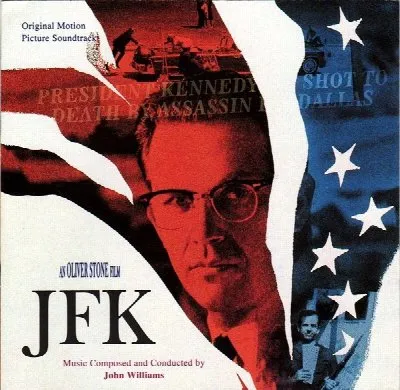
JFK
64 min · 18 tracks · contemporary classical music
Ceremonial brass and muffled drums give way to anxious strings as public mourning meets the atmosphere of a political thriller.
Top tracks — play these first
-
→
Prologue Start here — The opening establishes a ceremonial tone, framing the story in the language of public remembrance.
-
→
The Motorcade — Williams turns the procession toward Dallas into suspense music, giving the familiar historical event a sense of mounting dread.
-
→
Garrison’s Obsession — This cue shifts the focus from national ceremony to the pressure of the investigation, giving the score a more inward, unsettled character.
-
→
Arlington — The extended cue returns the score to the language of mourning, emphasizing solemnity rather than the momentum of a thriller.
Elevation
Our rating, out of 100 — and why.
AI-generated from five scored dimensions. An opinion, not a measurement.
InstrumentalThe album effectively blends orchestral themes with emotional depth, showcasing Williams' compositional skill in film scoring.
What we noticed
- The score features a recurring main theme that is developed and varied across multiple tracks, creating a cohesive musical narrative.
- Several tracks incorporate contrasting sections, shifting from somber melodies to more uplifting passages, reflecting the emotional complexity of the subject matter.
- Composition 25% of the score
-
8/10
- Craft 20% of the score
-
7/10
- Durability 25% of the score
-
6/10
- Distinctiveness 18% of the score
-
7/10
- Sequencing 12% of the score
-
8/10
the writing — melody, harmony, structure, lyrics
production, performance, arrangement
whether it rewards returning to it
whether it sounds like itself
running order, pacing, length
Known within its scene. Reported but not counted — how far a record travelled describes its reception rather than the record, and a newer release has had less time to travel than an older one.
Is this for you?
Good fit if you like
- dynamic journey with emotional peaks
- haunting orchestral landscapes unfold
- reflective moments of historical gravity
- engaging narrative through sound
- for thoughtful contemplation
Maybe skip if you
- seeking fast-paced instant gratification
- prefer standalone tracks over cohesion
Where this album fits
- In the catalog
- Breakthrough — JFK marked Williams' return and showcased his film scoring prowess, enhancing his reputation.
- Themes
- Dallas motorcade· Kennedy assassination· Garrison's conspiracy investigation· Cold War-era political mistrust
- Career context
- JFK arrived in 1991, after John Williams had already established himself through scores for Star Wars and the Indiana Jones films. It reunited him with director Oliver Stone, following their collaboration on Born on the Fourth of July in 1989.
- Stylistic neighbors
- Jerry Goldsmith· James Horner· Alan Silvestri
Moments worth listening for
Where the writing does something specific.
-
On the Sunny Side of the Street
The refrain turns a change in outlook into a literal crossing from one side of the street to the other.
That concrete movement gives the song’s optimism an easy, danceable shape within a soundtrack otherwise dominated by suspense and grief.
Tracklist
- 1 Prologue Start here 4:01
- 2 The Motorcade 5:15
- 3 Drummers’ Salute 2:56
- 4 Theme from JFK 2:24
- 5 Eternal Father, Strong to Save 1:20
- 6 Garrison’s Obsession 2:34
- 7 On the Sunny Side of the Street 4:25
- 8 The Conspirators 4:06
- 9 The Death of David Ferrie 2:48
- 10 Maybe September 4:04
- 11 Garrison Family Theme 2:14
- 12 Ode to Buckwheat 3:55
- 13 El Watusi 2:42
- 14 The Witnesses 2:47
- 15 Concerto for Horn and Orchestra No. 2, K. 417: I. Allegro maestoso 6:30
- 16 Arlington 6:30
- 17 Finale 3:15
- 18 Theme from JFK (reprise) 2:23
Reference: Wikipedia · MusicBrainz · Wikidata
Sync your library
Everything you track here works immediately — no account needed. Create one when you want to sync across devices.