

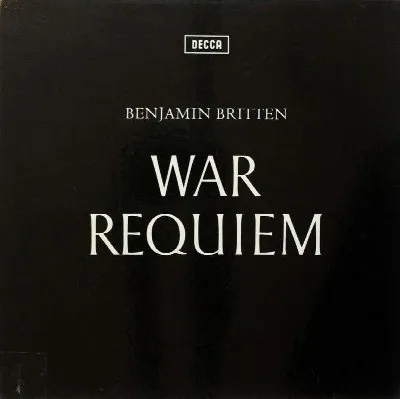
War Requiem
Benjamin Britten · 1963
81 min · 19 tracks · classical music
Cathedral-scale ritual meets the intimate shock of Wilfred Owen’s war poetry in music that moves between ceremony and desolation.
Top tracks — play these first
-
→
War Requiem, op. 66: I. Requiem aeternam: Requiem aeternam Start here — establishes the sonic palette early
-
→
War Requiem, op. 66: I. Requiem aeternam: What passing bells for these who die as cattle? — Pears’s tenor cuts into the opening ritual with Owen’s account of battlefield death, establishing the tension between the formal requiem and the poems’ stark witness.
-
→
War Requiem, op. 66: II. Dies irae: Move him into the sun — A plea to revive a fallen soldier becomes a devastating question about creation itself, set against the lingering weight of the Latin lament.
-
→
War Requiem, op. 66: III. Offertorium: So Abram rose, and clave the wood — Tenor and baritone recount Owen’s altered Abraham story over the chamber orchestra, turning a familiar biblical rescue into an indictment of sacrifice.
-
→
War Requiem, op. 66: VI. Libera me: It seemed that out of battle I escaped — The two male soloists meet in Owen’s imagined underworld, where the encounter between soldiers leads toward the work’s quiet final reconciliation.
Elevation
Our rating, out of 100 — and why.
AI-generated from five scored dimensions. An opinion, not a measurement.
Britten's War Requiem masterfully blends orchestral and vocal elements to create a profound commentary on war.
What we noticed
- The work integrates orchestral music with choral and solo vocal elements, alternating between the Latin Mass and Wilfred Owen's poetry.
- Each section of the Requiem is divided into multiple movements, creating a complex structure that contrasts solemnity with moments of intense emotional expression.
- The orchestration features a large ensemble, including strings, brass, and woodwinds, which dynamically shift in intensity throughout the piece.
- Composition 25% of the score
-
9/10
- Craft 20% of the score
-
8/10
- Durability 25% of the score
-
8/10
- Distinctiveness 18% of the score
-
9/10
- Sequencing 12% of the score
-
7/10
the writing — melody, harmony, structure, lyrics
production, performance, arrangement
whether it rewards returning to it
whether it sounds like itself
running order, pacing, length
Significant within its genre. Reported but not counted — how far a record travelled describes its reception rather than the record, and a newer release has had less time to travel than an older one.
Is this for you?
Good fit if you like
- haunting emotional reflections
- immersive orchestral storytelling
- thoughtful contemplation of loss
- cathartic moments of release
- profound engagement with themes
Maybe skip if you
- seeking upbeat, lively tracks
- prefer short, standalone pieces
Where this album fits
- In the catalog
- Breakthrough — This album established Britten's reputation as a leading composer post-WWII.
- Themes
- World War II devastation· Wilfred Owen's battlefield poetry· civilian air-raid ruins· war dead and peace
- Career context
- Britten composed War Requiem for the 1962 consecration of the rebuilt Coventry Cathedral, replacing the building destroyed in a Second World War air raid. He conducted this 1963 recording with soloists Peter Pears, Dietrich Fischer-Dieskau and Galina Vishnevskaya; Vishnevskaya had been prevented from singing at the premiere by Soviet authorities.
- Stylistic neighbors
- Gustav Holst· Dmitri Shostakovich· Arthur Benjamin
Tracklist
Disc 1
- 1 War Requiem, op. 66: I. Requiem aeternam: Requiem aeternam Start here 5:57
- 2 War Requiem, op. 66: I. Requiem aeternam: What passing bells for these who die as cattle? 3:38
- 3 War Requiem, op. 66: II. Dies irae: Dies irae 3:37
- 4 War Requiem, op. 66: II. Dies irae: Bugles sang, saddening the evening air 2:34
- 5 War Requiem, op. 66: II. Dies irae: Liber scriptus proferetur 2:57
- 6 War Requiem, op. 66: II. Dies irae: Out there, we've walked quite friendly up to Death 1:57
- 7 War Requiem, op. 66: II. Dies irae: Recordare Jesu pie 4:30
- 8 War Requiem, op. 66: II. Dies irae: Be slowly lifted up 2:10
- 9 War Requiem, op. 66: II. Dies irae: Confutatis 1:11
- 10 War Requiem, op. 66: II. Dies irae: Lacrimosa dies illa 1:54
- 11 War Requiem, op. 66: II. Dies irae: Move him into the sun 4:50
- 12 War Requiem, op. 66: III. Offertorium: Domine Jesu Christe 3:30
- 13 War Requiem, op. 66: III. Offertorium: So Abram rose, and clave the wood 6:08
Disc 2
- 1 War Requiem, op. 66: IV. Sanctus: Sanctus, sanctus, sanctus 6:06
- 2 War Requiem, op. 66: IV. Sanctus: After the blast of lightning from the East 3:50
- 3 War Requiem, op. 66: V. Agnus Dei: One ever hangs where shelled roads part 3:40
- 4 War Requiem, op. 66: VI. Libera me: Libera me, Domine 7:36
- 5 War Requiem, op. 66: VI. Libera me: It seemed that out of battle I escaped 9:33
- 6 War Requiem, op. 66: VI. Libera me: Let us sleep now / In Paradisum 5:33
What to play next

Rejoice in the Lamb / Missa brevis / A Ceremony of Carols
1965
Continues themes of spirituality and choral expression with rich orchestral textures.
Spring Symphony
1961
If this landed
Records by other artists that run on the same instinct.
Symphony no. 13 (Babi Yar)
Dmitri Shostakovich
Pairs large-scale orchestral writing and chorus with a stark remembrance of wartime atrocity and human suffering.
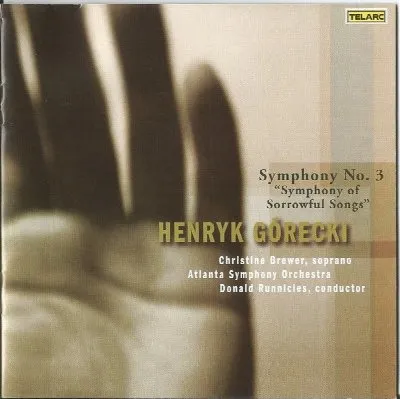
Symphony no. 3 "Symphony of Sorrowful Songs"
Henryk Górecki
Shares the orchestral lament and vocal focus, turning private loss and wartime absence into a sustained elegy.
Reference: Wikipedia · MusicBrainz · Wikidata
Sync your library
Everything you track here works immediately — no account needed. Create one when you want to sync across devices.