


Photo: Joost Evers / Anefo · CC BY-SA 3.0 nl

The Northsound field guide
Where to start with Pierre Boulez
Start with the chamber textures of Le Marteau sans maître, then branch into piano and orchestral works.
Boulez’s music asks you to listen closely: small instrumental gestures, shifting rhythms, and sudden changes in texture do much of the work. Start with a compact chamber piece, then follow the thread toward his larger-scale and more spatially ambitious writing.
- What they sound like
- Expect contemporary classical music built from intricate rhythms, sharply changing instrumental colors, and tension that rarely resolves in a conventional way. Boulez’s writing rewards focused listening more than background play.
- You'll like this if
- You’ll connect with Boulez if you enjoy hearing how instruments interact and are willing to follow music that avoids familiar melodies and regular pulse. His work may appeal especially to listeners curious about modern chamber music.
01 · Your first stop
Start here.
New to Pierre Boulez? You don’t need to hear everything. Start with this.

Your first album
Le Marteau sans maître
1964 ·Best starting point
This recording centers on Le Marteau sans maître, where a contralto voice moves among instruments including alto flute, viola, guitar, and percussion. The changing colors offer a clear way into Boulez’s sound before you tackle the broader forms of Répons or Pli selon Pli.
Only have a few minutes?
“L’artisanat furieux”
Listen for the contrast between the voice and the lean instrumental colors, which makes the album’s chamber-scale interplay easy to notice.
Not the album for you? Try one of these instead.
-
Orchestral Works & Chamber Music (2000) Choose Orchestral Works & Chamber Music if you would rather sample Boulez across ensemble settings before settling into one work.

-
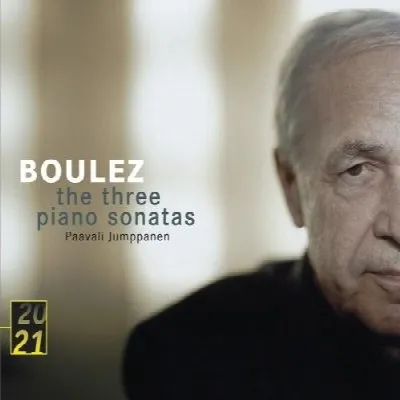
The Three Piano Sonatas (2005) Choose The Three Piano Sonatas if you want to hear his ideas concentrated in solo piano writing, without a vocal or orchestral texture.
-
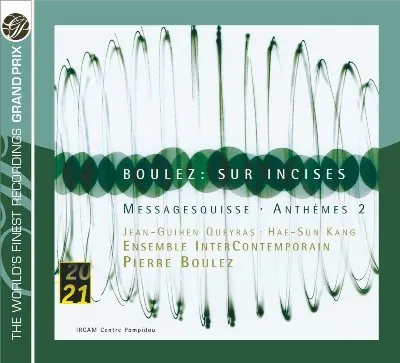
Sur Incises / Messagesquisse / Anthèmes 2 (2000) Choose Sur Incises / Messagesquisse / Anthèmes 2 if you are drawn to bright instrumental colors and more intricate, contemporary ensemble writing.
02 · The trail ahead
Listening paths
Pick a route through Pierre Boulez's catalog.
Follow Boulez from landmark modernism through large-scale and orchestral thinking.
-
1Le Marteau sans maître (1964) Start with the landmark blend of voice, instruments, and intricate texture.
-
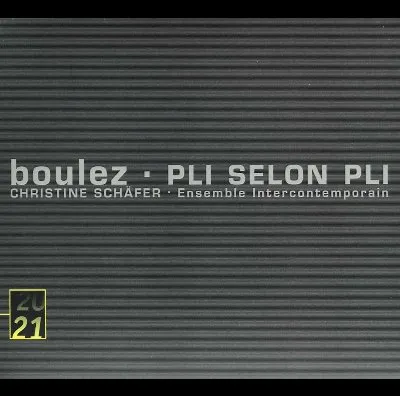
2Pli selon Pli (2002) Expand into a more extended, shifting orchestral and vocal landscape.
-
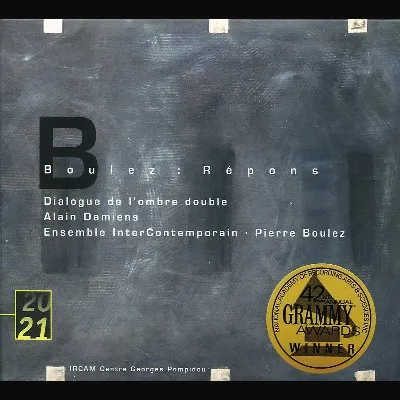
3Répons / Dialogue de l’ombre double (1998) Hear his spatial and electronic ideas sharpen the sense of musical space.
-
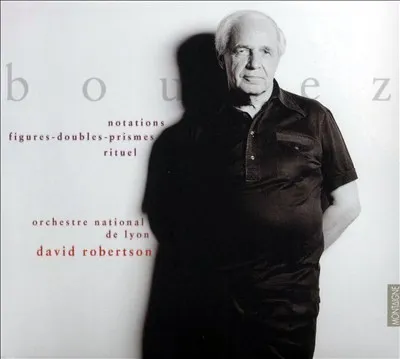
4Notations / Figures-Doubles-Prismes / Rituel (2003) Close with orchestral works that reveal his command of scale and color.
Begin with familiar orchestral ground, then move toward Boulez’s own sound world.
-
1Beethoven: Symphony No. 5 in C Minor, Op. 67 & Meeresstille und glückliche Fahrt, Op. 112 - Mahler: Symphony No. 10 (1970) Start with familiar composers to hear Boulez’s clarity as a conductor.

-
2Boulez Conducts Stravinsky (2017) Move to vivid, rhythmically direct orchestral music from a modernist peer.

-
3Orchestral Works & Chamber Music (2000) Sample contrasting settings before focusing on Boulez’s signature works.
-
4Le Marteau sans maître (1964) Finish with a focused encounter with his distinctive vocal chamber music.
Explore Boulez at his most intricate, from piano structures to spatial and ensemble works.
-
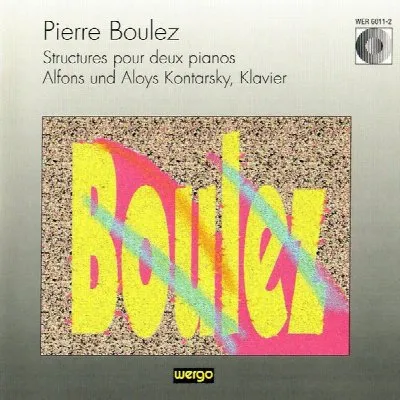
1Structures pour deux pianos (1992) Begin with tightly organized piano writing and concentrated interplay.
-
2Sur Incises / Messagesquisse / Anthèmes 2 (2000) Hear the textures widen through resonant instruments and electronics.
-
3Répons / Dialogue de l’ombre double (1998) Follow those ideas into spatial sound and a more immersive scale.
-
4Livre pour Quatuor (2025) End with chamber music that tests attention through dense ensemble detail.

03 · Beyond this guide
Where to go next
-
Karlheinz Stockhausen For intricate postwar modernism, tightly controlled rhythms, and shifting instrumental textures that build a similarly demanding, immersive sound world. Start with Mantra (1999)

-
Luciano Berio His dense orchestral writing and restless transformations of musical material offer a vivid counterpart to Boulez’s serial complexity. Start with Sinfonia (1969)

-
Iannis Xenakis Try him for fiercely intricate rhythms and massive, evolving sound masses that turn orchestral tension into a physical experience. Start with Pléïades (1987)

04 · Keep exploring
The Weekly Dispatch
Every Tuesday, a few more places to start listening.
One short email. Free, unsubscribe anytime. Read this week's.
Common questions
Where should I start with Pierre Boulez?
Start with Le Marteau sans maître (1964). This recording centers on Le Marteau sans maître, where a contralto voice moves among instruments including alto flute, viola, guitar, and percussion. The changing colors offer a clear way into Boulez’s sound before you tackle the broader forms of Répons or Pli selon Pli.
What does Pierre Boulez sound like?
Expect contemporary classical music built from intricate rhythms, sharply changing instrumental colors, and tension that rarely resolves in a conventional way. Boulez’s writing rewards focused listening more than background play. Rooted in classical.
In what order should I listen to Pierre Boulez's albums?
In release order: "Trois sonates pour piano" (1981), "Rituel / Eclat/Multiples" (1983), "Sonate pour piano n°1 - Sonatine (BBC Singers, Ensemble InterContemporain feat. director: Pierre Boulez)" (1991), "Piano Sonatas nos. 1 - 3" (1995), "Répons / Dialogue de l’ombre double" (1998), "Sur Incises / Messagesquisse / Anthèmes 2" (2000), "Pli selon Pli" (2002), "Notations / Figures-Doubles-Prismes / Rituel" (2003), "Le Marteau sans maître / Dérive 1 & 2" (2005) and "The Three Piano Sonatas" (2005).
Which artists should I listen to after Pierre Boulez?
Try Karlheinz Stockhausen (start with "Mantra"), Luciano Berio (start with "Sinfonia") and Iannis Xenakis (start with "Pléïades").