


Photo: Rob Croes / Anefo · CC0

The Northsound field guide
Where to start with Olivier Messiaen
Start with chamber music, then follow Messiaen toward piano, orchestra, and birdsong.
Messiaen can move from a hushed chamber passage to music that seems to suspend time, with harmony and rhythm doing as much expressive work as melody. Start with the intimate Quartet for the End of Time; if you want a larger, more brightly colored sound, try Turangalîla-Symphonie instead.
- What they sound like
- Messiaen’s music pairs unusual rhythmic patterns with sustained, vivid harmonies; it can feel meditative one moment and sharply animated the next. His sound ranges from a small chamber ensemble to a large orchestra.
- You'll like this if
- You’ll connect with this if you enjoy attentive, slow-moving passages as well as music whose rhythms and instrumental colors keep shifting. The Quartet is a good test if you prefer hearing those ideas in a small ensemble before taking on a long orchestral work.
01 · Your first stop
Start here.
New to Olivier Messiaen? You don’t need to hear everything. Start with this.

Your first album
Quatuor pour la Fin du Temps
1990 ·Best starting point
This chamber work makes Messiaen’s unusual rhythms and sustained harmonic colors easy to hear without the scale of his orchestral pieces. Its changing pace and textures offer a focused introduction before you move on to the much larger Turangalîla-Symphonie.
Only have a few minutes?
“Louange à l'Éternité de Jésus” from Quatuor pour la fin du Temps (2018)
Its slow, sustained lines let you settle into Messiaen’s spacious harmony before exploring the Quartet’s more rhythmically active movements.
Not the album for you? Try one of these instead.
-
Turangalîla‐Symphonie (1991) Choose Turangalîla-Symphonie if you want the full orchestral scale, colorful instrumental writing, and more forceful rhythmic contrasts from the outset.

-
Vingt regards sur l’enfant-Jésus (2002) Choose Vingt regards sur l’enfant-Jésus if you want to hear Messiaen’s piano writing unfold across a sequence of contrasting meditations.

-
Catalogue d'oiseaux / Petites esquisses d'oiseaux (1997) Choose Catalogue d'oiseaux if piano music inspired by birdsong and changing natural scenes sounds more inviting than chamber or orchestral works.

02 · The trail ahead
Listening paths
Pick a route through Olivier Messiaen's catalog.
Follow Messiaen from intimate chamber music to orchestral and spiritual expanses.
-
1Quartet for the End of Time (1995) Start with a focused chamber work that reveals his distinctive sound.

-
2Vingt regards sur l'enfant Jesus Move to piano meditations and a broader expression of his faith.

-
3Turangalîla Symphony (2007) Hear those colors and rhythms expand into a vast orchestral vision.

-
4Catalogue d'oiseaux (2005) Explore his birdsong writing through a sustained, detailed piano cycle.

-
5Saint François d'Assise (1998) Conclude with the monumental opera that gathers his spiritual concerns.

Begin with vivid, immediately distinctive works, then try more concentrated listening.
-
1Turangalîla Symphony (2007) Its bold orchestral colors offer a direct, exhilarating first encounter.
-
2Quartet for the End of Time (1995) A clear chamber setting makes his unusual harmonies easier to follow.
-
3Vingt regards sur l'enfant Jésus (1994) The piano cycle rewards longer listening with varied, vivid tableaux.
-
4Catalogue d'oiseaux (2005) Finish with patient, finely detailed piano portraits of birdsong.
Trace birdsong, striking rhythmic invention, and late orchestral abstraction.
-
1Oiseaux exotiques (1959) Begin with compact, brilliant orchestral writing shaped by birdsong.

-
2Messiaen: 7 Haïkaï / Eloy: Équivalences / Pousseur: Madrigal III (1971) Hear birdsong and sharply articulated instrumental colors in compressed form.

-
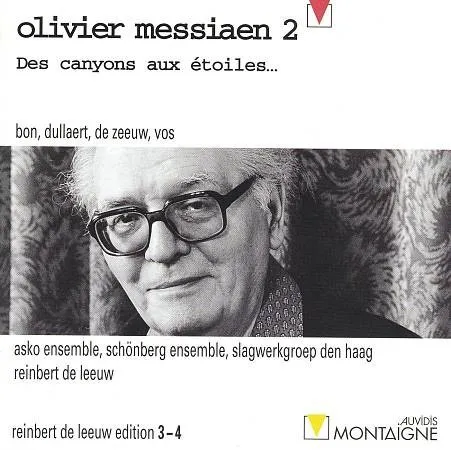
3Des canyons aux étoiles... (1994) Open out into a spacious, vividly colored exploration of landscape.
-
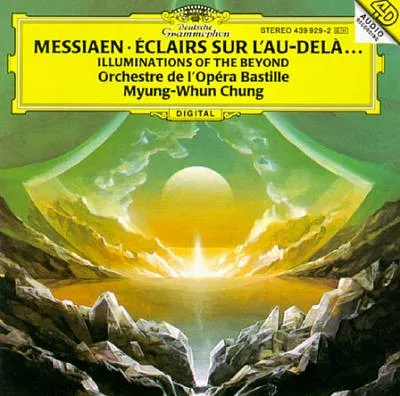
4Éclairs sur l'Au-delà... (1994) End with late orchestral writing of striking scale and abstraction.
03 · Beyond this guide
Where to go next
-
Claude Debussy Debussy’s shimmering orchestral colors, modal writing, and fluid sense of time offer an earlier route into the harmonic atmosphere Messiaen expanded. Start with La Mer / Nocturnes (1988)

-
Kaija Saariaho Saariaho uses sustained textures, spectral blends, and luminous orchestral color to create expansive sound worlds with a modern edge. Start with Maa (1992)

-
György Ligeti Ligeti’s dense textures, intricate rhythmic layering, and vividly shifting sonorities connect with the more startling, complex side of Messiaen. Start with Le Grand Macabre (1999)

04 · Keep exploring
The Weekly Dispatch
Every Tuesday, a few more places to start listening.
One short email. Free, unsubscribe anytime. Read this week's.
Common questions
Where should I start with Olivier Messiaen?
Start with Quatuor pour la Fin du Temps (1990). This chamber work makes Messiaen’s unusual rhythms and sustained harmonic colors easy to hear without the scale of his orchestral pieces. Its changing pace and textures offer a focused introduction before you move on to the much larger Turangalîla-Symphonie.
What does Olivier Messiaen sound like?
Messiaen’s music pairs unusual rhythmic patterns with sustained, vivid harmonies; it can feel meditative one moment and sharply animated the next. His sound ranges from a small chamber ensemble to a large orchestra. Rooted in opera and symphony.
In what order should I listen to Olivier Messiaen's albums?
In release order: "Turangalîla‐Symphonie" (1991), "Visions de l'Amen / Hymne" (1993), "Quatuor pour la Fin du Temps / Cinq Rechants" (1993), "Éclairs sur l'Au-delà..." (1994), "Concert à quatre / Les Offrandes oubliées / Le Tombeau resplendissant / Un sourire" (1995), "Et exspecto resurrectionem mortuorum / Chronochromie / La Ville d’en Haut" (1995), "Quartet for the End of Time" (1995), "Catalogue d'oiseaux / Petites esquisses d'oiseaux" (1997), "Messiaen: Quatuor pour la fin du temps / Schönberg: Ein Stelldichein / Martinů: Oboe Quartet" (1997) and "Saint François d'Assise" (1998).
Which artists should I listen to after Olivier Messiaen?
Try Claude Debussy (start with "La Mer / Nocturnes"), Kaija Saariaho (start with "Maa") and György Ligeti (start with "Le Grand Macabre").